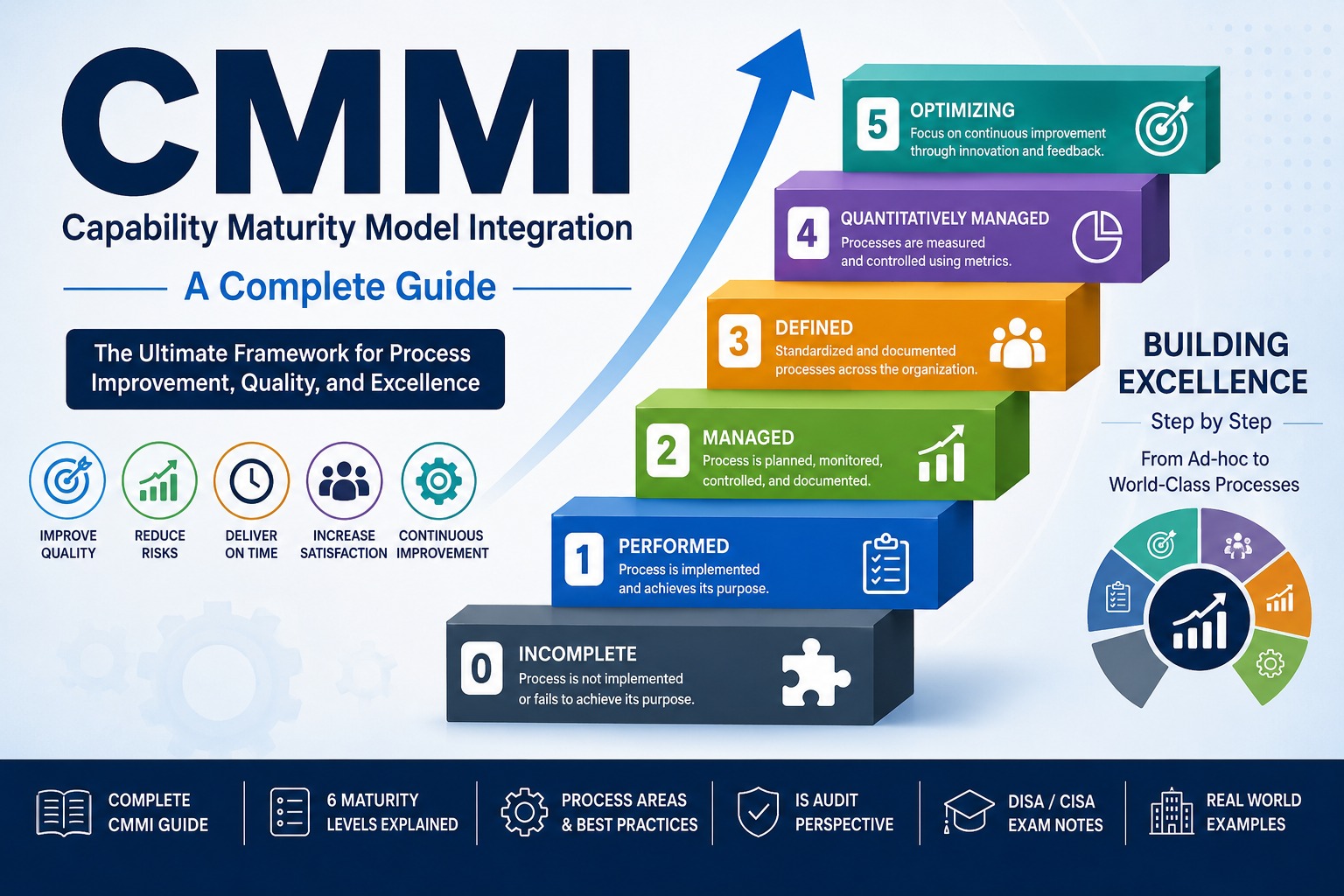
The Ultimate Guide to Capability Maturity Model Integration (CMMI)
Capability Maturity Model Integration (CMMI) is a globally recognized process improvement framework designed to help organizations enhance the quality, efficiency, and predictability of their software development, project management, and service delivery.
According to the ICAI DISA/ISA 3.0 Module 3, CMMI is defined as:
“A process improvement approach that provides enterprises with the essential elements of effective processes. It helps integrate organizational functions, establish process improvement goals, improve quality, and evaluate current processes.”
1. History of CMMI
To understand CMMI, it helps to know its origins. The original Capability Maturity Model (CMM) was developed in the late 1980s by the Software Engineering Institute (SEI) at Carnegie Mellon University, USA, under the sponsorship of the U.S. Department of Defense (DoD).
Initially, separate maturity models existed for Software Engineering, Systems Engineering, Integrated Product Development, and Supplier Management. Organizations using multiple models faced duplicate efforts, conflicting terminology, and high assessment costs. To solve this, SEI introduced Capability Maturity Model Integration (CMMI) in 2002, unifying these independent models into one cohesive framework. Today, it is maintained by the CMMI Institute and is used globally across IT, finance, manufacturing, healthcare, and government sectors.
2. Evolution of CMMI
| Version | Year | Major Improvement |
|---|---|---|
| CMM | 1991 | The original software maturity model focused strictly on software engineering. |
| CMMI 1.1 | 2002 | Integration of multiple standalone maturity models into a single framework. |
| CMMI 1.2 | 2006 | Enhanced focus on better project management and hardware/software integration. |
| CMMI 1.3 | 2010 | Introduction of Agile support and improved service delivery guidelines. |
| CMMI V2.0 | 2018 | Simplified model designed to seamlessly integrate with Agile, DevOps, and modern security practices. |
3. Core Components of CMMI
When studying for certifications like CISA or DISA, understanding the structural components of CMMI is crucial. The framework is built on:
- Maturity Levels: Measure the overall process maturity of the entire organization.
- Capability Levels: Measure the maturity of a specific, individual process.
- Process Areas: Clusters of related practices that must be implemented to satisfy a specific maturity level (e.g., Risk Management).
- Specific Goals: The unique characteristics that must be present to satisfy a particular Process Area.
- Specific Practices: The actual activities performed to achieve the Specific Goals.
- Generic Goals: Goals that apply universally across multiple Process Areas to ensure the process is institutionalized.
- Generic Practices: The activities performed to achieve Generic Goals (like providing training or measuring a process).
4. CMMI Architecture Workflow
The practical application of CMMI flows from high-level business objectives down to specific continuous improvements:
Business Goals → Process Areas → Specific Goals → Specific Practices → Measured Results → Continuous Improvement
5. Process Areas by Maturity Level
Each maturity level contains specific Process Areas (PAs) that an organization must master before moving to the next level.
Level 2: Managed
- Requirements Management (REQM)
- Project Planning (PP)
- Project Monitoring and Control (PMC)
- Supplier Agreement Management (SAM)
- Measurement and Analysis (MA)
- Process and Product Quality Assurance (PPQA)
- Configuration Management (CM)
Level 3: Defined
- Requirements Development
- Technical Solution
- Product Integration
- Verification & Validation
- Organizational Process Focus & Definition
- Organizational Training
- Integrated Project Management
- Risk Management
- Decision Analysis and Resolution
Level 4: Quantitatively Managed
- Organizational Performance Management (OPM)
- Quantitative Project Management (QPM)
Level 5: Optimizing
- Causal Analysis and Resolution (CAR)
- Organizational Innovation and Deployment
6. The Six Maturity Levels Explained
The framework evaluates organizations across six maturity levels (0 through 5).
| Level | Name | Description |
|---|---|---|
| 0 | Incomplete | Process is not implemented or fails; chaotic environment. |
| 1 | Performed | Process achieves its purpose but relies on individual heroics. |
| 2 | Managed | Processes are planned, monitored, controlled, and documented. |
| 3 | Defined | Standardized, organization-wide processes are established. |
| 4 | Predictable | Processes are measured using metrics and statistical tools. |
| 5 | Optimizing | Focus shifts to continuous improvement and root-cause analysis. |
Easy Exam Mnemonic: I – P – M – D – P – O (Incomplete, Performed, Managed, Defined, Predictable, Optimizing)
7. Capability Levels vs. Maturity Levels
Organizations can adopt CMMI using two distinct paths. Understanding the difference between these levels is a frequent exam topic.
| Feature | Capability Level | Maturity Level |
|---|---|---|
| Focus | Individual Process | Entire Organization |
| Scope | Measures a specific process area | Measures overall enterprise maturity |
| Scale | Levels 0 to 3 | Levels 1 to 5 |
| Representation | Continuous Representation | Staged Representation |
8. CMMI Assessment Method
Companies do not just “claim” a CMMI level; they must be formally appraised. The historical standard was the SCAMPI (Standard CMMI Appraisal Method for Process Improvement), which has evolved into the Benchmark Appraisal in CMMI V2.0. Appraisals involve:
- Gap Analysis: Identifying what is missing compared to the CMMI model.
- Documentation Review: Examining policies, standard operating procedures, and SDLC templates.
- Interviews: Speaking with project managers and developers to confirm processes are actually followed.
- Observation & Evidence Collection: Gathering metrics, logs, and meeting minutes to prove institutionalization.
9. Real-World Adoption
Global IT service providers heavily rely on CMMI to assure clients of their reliability, quality, and risk management capabilities. Notable companies operating at CMMI Level 5 include:
- Infosys
- Tata Consultancy Services (TCS)
- Wipro
- HCL Technologies
- IBM
- Accenture
- Capgemini
- Cognizant
- Tech Mahindra
10. Benefits by Stakeholder
| Stakeholder | Key Benefits |
|---|---|
| Management | Lower operational costs, predictable planning, minimized project risk. |
| Developers | Clear requirements, standardized documentation, significantly reduced rework. |
| Customers | Higher product quality, faster delivery times, reliable schedules. |
| IS Auditors | Easier compliance tracking, accessible evidence, robust internal IT controls. |
11. CMMI and the SDLC
CMMI does not replace the Software Development Life Cycle (SDLC); it acts as a quality wrapper around it.
Requirement → Analysis → Design → Coding → Testing → Implementation → Maintenance
At every phase of this cycle, CMMI introduces structured checkpoints:
- Requirements: Managed and traced (Level 2).
- Coding/Design: Standardized across all teams (Level 3).
- Testing: Measured statistically for defect density (Level 4).
- Maintenance: Automated and continuously improved based on feedback (Level 5).
12. CMMI in Modern IT: Agile & DevOps
A common misconception is that Agile replaces CMMI. In reality, they serve different purposes and complement each other.
CMMI vs. Agile
| Feature | Agile | CMMI |
|---|---|---|
| Nature | Development methodology | Process improvement framework |
| Focus | Team-level execution | Enterprise-wide standardization |
| Structure | Flexible, sprint-based | Standardized, milestone-based |
CMMI and DevOps
CMMI V2.0 was specifically designed to support modern DevOps practices. By reaching higher maturity levels, organizations naturally build the discipline required for:
- Continuous Integration (CI) and Continuous Delivery (CD)
- Automated Testing and Deployment
- Continuous Monitoring of system health
- Data-driven continuous improvement
13. Framework Comparisons for Auditors
Information Systems Auditors must understand when to apply CMMI versus other global standards.
CMMI vs. ISO 9001
| Feature | CMMI | ISO 9001 |
|---|---|---|
| Primary Goal | Process maturity and optimization | Baseline quality management system |
| Structure | Maturity levels (1-5) | Pass/Fail certification (no maturity levels) |
| Origin | IT and Software focused | Industry independent |
CMMI vs. COBIT vs. ITIL
| Framework | Core Focus |
|---|---|
| CMMI | Process Improvement & Software Engineering |
| COBIT | Enterprise IT Governance & Management |
| ITIL | IT Service Management (ITSM) |
| ISO 27001 | Information Security Management |
| PMBOK | Project Management |
14. Common Implementation Challenges
While powerful, implementing CMMI is not easy. Organizations frequently face:
- High Implementation Cost: Appraisals and consulting fees are expensive.
- Documentation Burden: Requires a massive shift toward formalizing records.
- Resistance to Change: Employees often prefer ad-hoc, informal methods.
- Training Overhead: Staff must be continually educated on standard processes.
- Management Commitment: Requires years of sustained backing from the C-suite.
15. Frequently Asked Questions (FAQ)
What is the difference between CMM and CMMI?
CMM was the original model focused only on software. CMMI integrates multiple disciplines (software, hardware, acquisition, and services) into a single framework.
Is CMMI Level 5 the end of the journey?
No. Level 5 is called “Optimizing,” meaning the organization has built a culture and system that continuously finds new ways to improve, innovate, and automate.
Can Agile and CMMI be used together?
Absolutely. Agile dictates how the team builds the software daily, while CMMI dictates how the organization ensures the Agile teams are consistent, measuring quality, and learning from each other.
Is CMMI still relevant in the era of Cloud and AI?
Yes. CMMI V2.0 updated the framework to align with DevOps, security, and automation. As long as organizations need predictable, high-quality project delivery, process maturity remains critical.
16. Key Takeaways
Capability Maturity Model Integration (CMMI) is a globally recognized process improvement framework that enables organizations to transition from chaotic, hero-driven project management (Levels 0/1) to optimized, data-driven, and continuously improving environments (Level 5).
By standardizing workflows, measuring metrics quantitatively, and enforcing rigorous configuration and requirements management, CMMI reduces project risk and drives customer satisfaction. For IS Auditors and IT management, CMMI serves as the ultimate benchmark for evaluating the reliability, governance, and maturity of an organization’s software development lifecycle.